The AI Economic Control System

Cut AI costs. Control agent spending.
Prove ROI.

Connect Claude Code, Cursor, and Copilot company-wide in under ten minutes, and start saving the same day.

Free — 100,000 transactions/mo   No credit card   No code changes

app.revenium.ai — AI by Employee ▶ 1:35
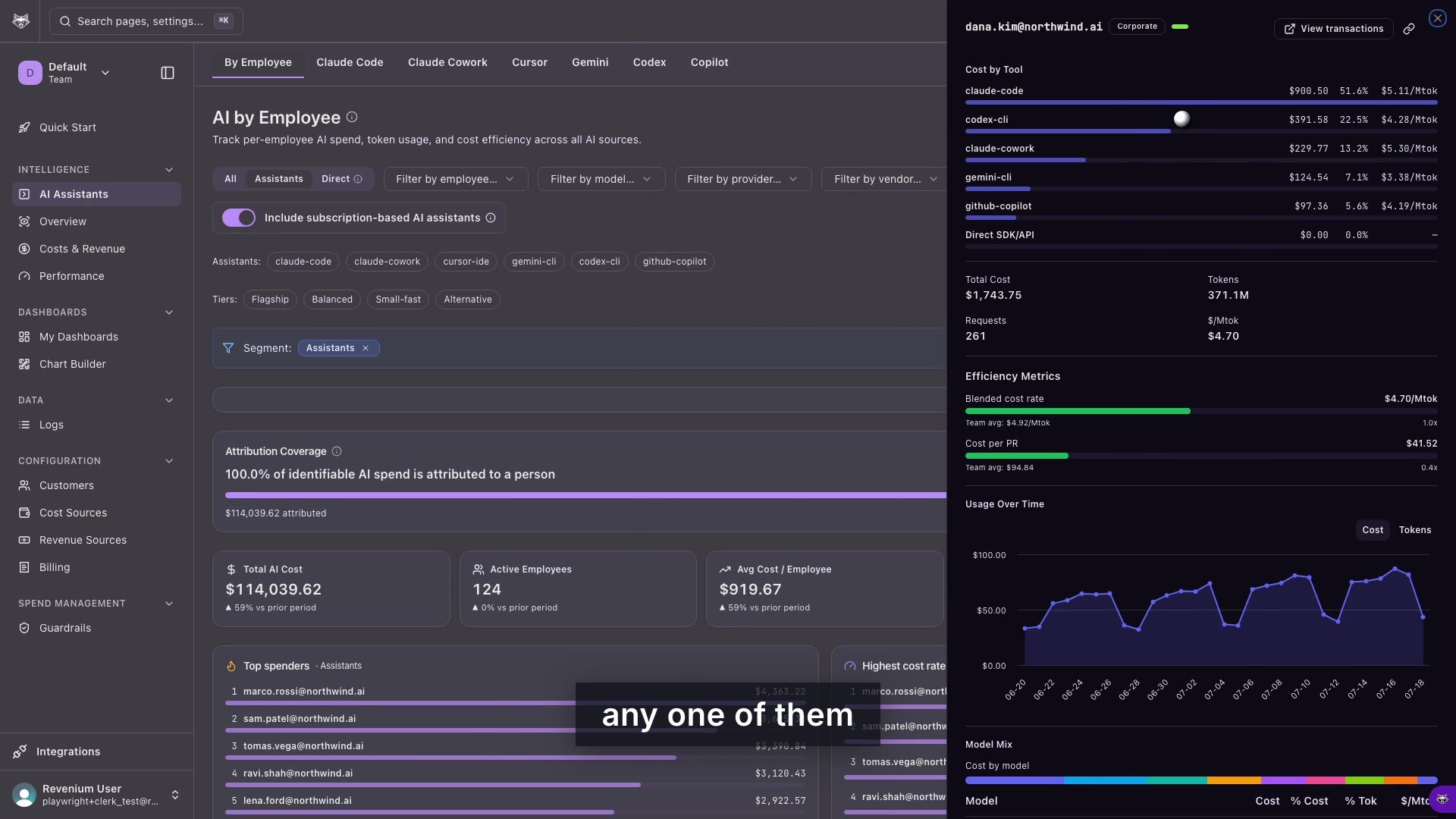
Revenium AI by Employee dashboard — per-developer spend across Claude Code, Cursor, Copilot, Gemini, and Codex

Recorded in the product. Per-developer AI spend across Claude Code, Claude Cowork, Cursor, Gemini, Codex, and Copilot — with cost per PR, blended $/Mtok, model mix, and 100% of identifiable spend attributed to a person.

40%AI-cost reduction at one 124-developer customer, while usage grew 4×
<10 minfrom signup to your entire engineering org reporting — one config block, zero per-developer installs
70–80%of most companies' AI spend runs through engineering — bring your biggest line item under control first
AI spend is the fastest-growing line item you can't explain

Agents spend autonomously, across every provider — and the tools you have weren't built to catch it.

02:47 AM

A runaway bill hits overnight

One mis-configured key burned $90K in a week. A retry loop ran a task three times before finishing. Costs pile up across providers and agents with no single view — and the bill arrives before the alert does.

How Revenium fixes itGuardrails watch every key against its own pattern and stop the runaway in flight. The alert arrives before the bill.

Owner: unknown

AI spend has no owner

You can see one big number, but not which team, customer, or agent spent it. Inference got 280× cheaper this decade — and spend exploded anyway. Nobody can say what drove the bill.

How Revenium fixes itEvery dollar is attributed to a person, team, customer, and agent, in one view across every provider.

Board meeting, Q3

The board wants proof you can't give

"You spent six figures on AI. What did we get?" 78% of leaders feel board pressure to prove AI value — and say old metrics can't. 65% say realizing ROI is proving difficult.

How Revenium fixes itCost per outcome, measured per PR, per ticket, and per customer, gives the board a number it accepts.

Where the savings come from

Those fixes explain the bill. These three mechanisms shrink it. They are how one 124-developer customer cut AI costs 40% while usage grew 4×, with no lockouts and no innovation tax.

FLAGSHIP BUDGETS

Developers self-correct

Give every developer a flagship-model budget. When it's spent, their work routes automatically to lower-cost models, with no tickets and no lockouts. Developers see the trade-off and make better calls on their own, and the model mix shifts without anyone policing it. When a limit does fire, the block message itself explains the fix: switch models and keep working.

ALERTS & BLOCKS

Runaways stopped early

Every key, person, and team is watched against its own pattern. Alerts fire the moment spend breaks pattern, and hard guardrails throttle or stop the transaction before it reaches the bill.

▶  Watch: a runaway stopped · 1:27
AI INSIGHTS

Savings found automatically

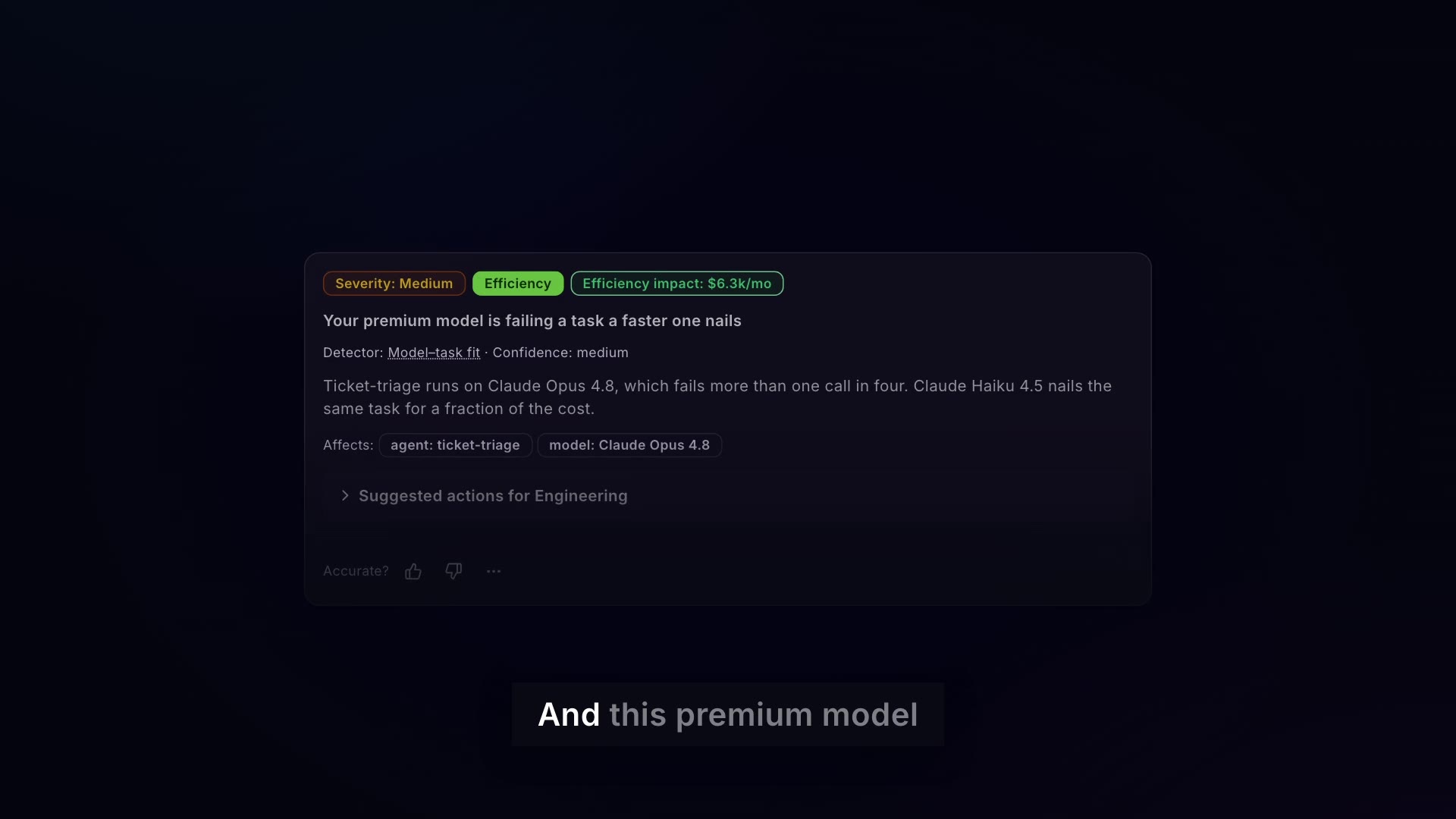
Revenium's AI reads your spend continuously and hands you specific, dollar-valued fixes: the agent re-running tasks 3×, the dormant keys, the oversized models. Apply the recommendation and the line item drops.

▶  Watch: $28K in savings found · 1:01
Org-wide setup in under ten minutes

Your whole engineering org, itemized in one sitting

No per-developer installs. No code changes. No pipeline engineering. One admin connects the company's AI coding assistants once — every developer starts reporting on their next session.

01

Paste one config block

Sign up, and Revenium generates a managed-settings block for your assistant — Claude Code shown here. An admin pastes it into Claude Console → Managed settings once. Cursor, Copilot, and Claude Cowork connect org-wide the same way, via admin UI or Admin-API sync.

claude-managed-settings.json · generated for your org at signup
// Generated for your org by Revenium
{
  "env": {
    "OTEL_METRICS_EXPORTER": "otlp",
    "OTEL_EXPORTER_OTLP_ENDPOINT":
      "https://otel.revenium.ai",
    "OTEL_EXPORTER_OTLP_HEADERS":
      "x-revenium-key=rev_org_••••••••"
  }
}
02

Developers report automatically

Every authenticated developer starts reporting on next startup — identity, model, tokens (including cache and reasoning), session, duration, and tier. You watch the roster fill live, in the same session.

0 developers reporting — and counting
03

The dashboards light up, and the caps go on

Cost per developer and per team. Cost per PR merged. Blended $/Mtok. Flagship-vs-efficient model mix. Peer-benchmarked productivity. The 70–80% of your AI bill that runs through engineering — finally itemized, and tied to output. Then put guardrails on what you found: budgets, alerts, and hard caps from day one.

The AI Economic Control System

Revenium connects AI activity to actual business outcomes. Each capability below is shown in the product itself. Press play.

01 · Economic Control

Save money now — and catch the runaways

Cut the waste already on your bill: old-model usage, retry loops, dormant keys, oversized models. Then set guardrails that start in shadow mode and alert before they're enforced.

  • Flagship budgets — when a developer's flagship budget is spent, work routes to lower-cost models automatically
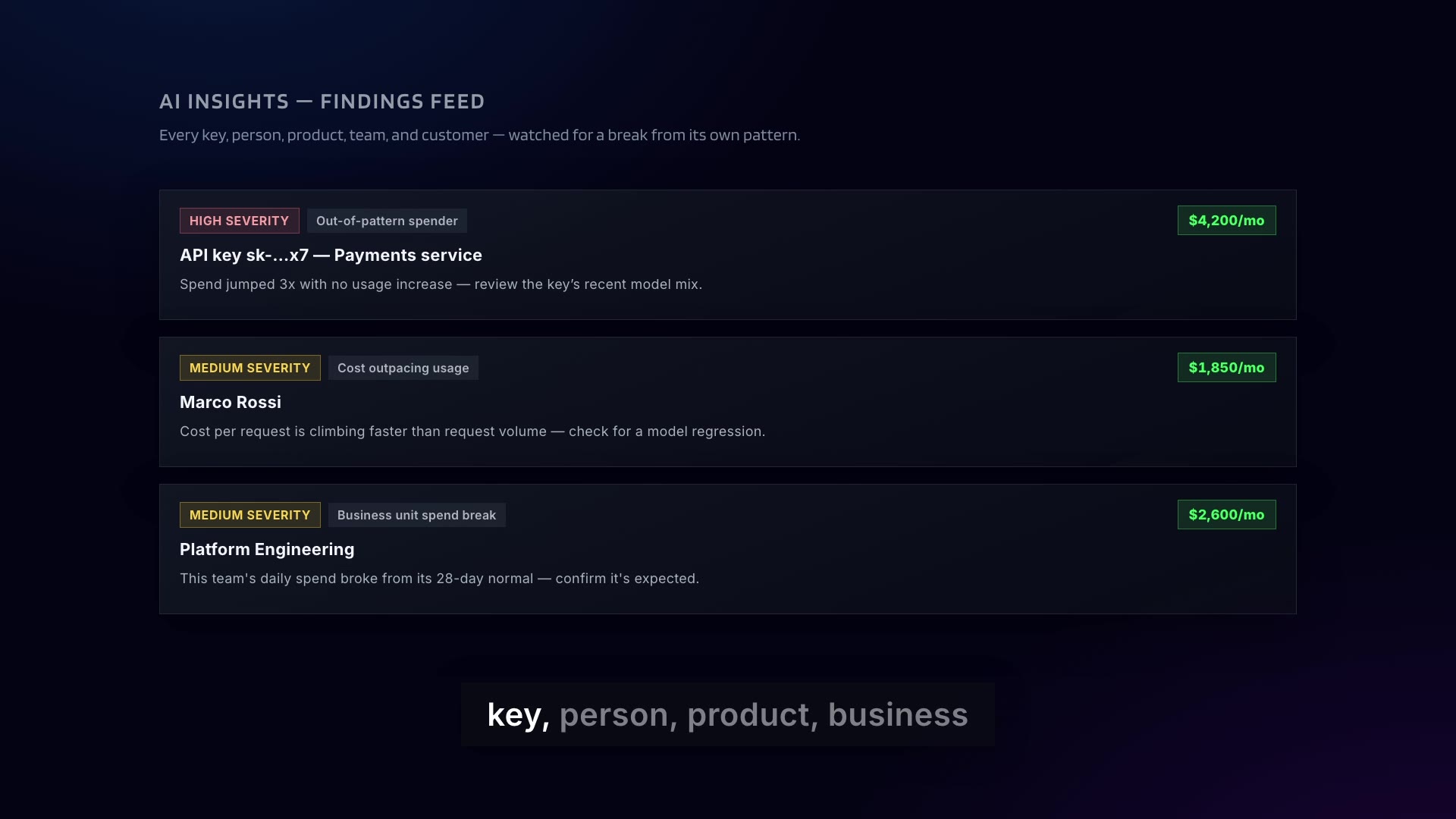
  • Anomaly detection — every key, person, team, and customer watched against its own pattern
  • Spend guardrails — throttle or stop transactions past threshold
  • Per-transaction limits — catch the $400 request in a $4 workflow
Anomaly alerts & guardrails — findings feed▶ 1:27
AI Insights findings feed — out-of-pattern spender alerts with severity and monthly impact
02 · Economic Observability

Know where every AI dollar goes

Every model call, agent turn, and tool call — attributed to the team, customer, feature, and agent behind it. An itemized record in real time, with detail no provider bill shows.

  • Deep attribution — customer, product, agent, model, provider
  • Tool Registry — the API and service costs gateways never see
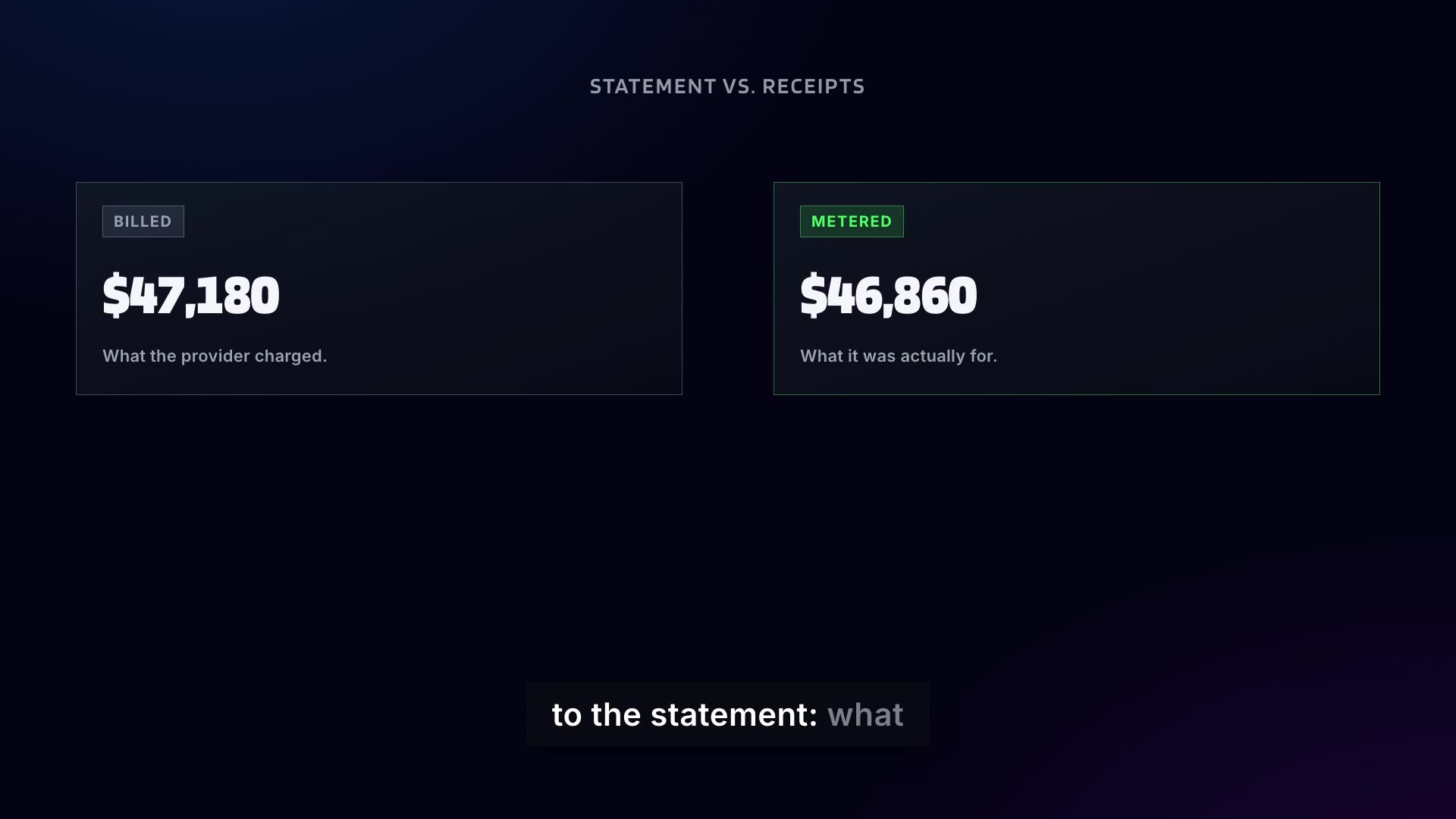
  • One statement that finally reconciles with vendor invoices
Invoice reconciliation — billed vs. metered▶ 0:56
Statement vs receipts — billed $47,180 vs metered $46,860
03 · Economic Intelligence

Know whether it was worth it

Connect cost to outcome: TCO, COGS, and ROI per workflow — including the tool calls and human review time behind each one. Then let Revenium's own AI find the money you're wasting.

  • AI Insights — savings recommendations with dollar values attached
  • Cost per outcome — per job, per customer, per PR merged
  • Forecasts that spot waste before it compounds
AI Insights — $28K of savings, found automatically▶ 1:01
AI savings recommendation — agents repeating work, $12.4k/mo potential savings

Start fast. Scale with confidence.

Engineering lands the data in minutes. Finance and product get the answers the same day.

Works with the AI stack you already run

Coding assistants connect via one admin config. Custom apps and agents add one lightweight SDK — or send standard OpenTelemetry. No proxies in your request path, no code rewrites.

Claude Code Claude Cowork Cursor GitHub Copilot Gemini CLI Codex OpenAI Anthropic Google Gemini AWS Bedrock Azure OpenAI Ollama Perplexity LangChain LiteLLM n8n GitHub GitLab Snowflake Datadog Cloudability Apptio S3 MCP

Technical question? Ask the docs

Get answers straight from our documentation — connection steps, data handling, API details — without losing this page. If an answer doesn't settle it, a human is one click away.

Start cutting your AI spend today

Connect your coding assistants in minutes, see where the money goes, and start cutting. Free.

10-minute org-wide setup Works with your existing stack 100K transactions free